Original Löwe 8.104 Anvil Secateurs – Product Review

Review by Michael Smith (Veshengro)

8_104_Aktion_1The Original Löwe 8.104 anvil pruning shears feature the ‘best of both worlds’, utilizing anvil technology with bypass geometry. The slimness and curve of a bypass cutting head, makes selective pruning of intensive crops (fruit, flowers, etc.) easy, while the anvil blade allows easy cutting and less impact during use.
Designed for use in horticulture, fruit growing, forestry, and viticulture; these pruners can be used left or right handed, for cutting any kind of wood with plastic grips and easily adjustable handles to suit any hand size.

It was the Löwe 1 which made the Original Löwe brand and the anvil principle (a drawing cut against a fixed base plate) world famous. Original Löwe pruners are designed, produced and assembled in Germany to the highest standards with a unique hardening process giving the blades an unrivaled hardness and the latest CNC grinding machines, ensuring an outstanding sharp cutting edge.

Length: 21cm

Weight: 230g

Cutting Capacity: 25mm (1")

While it is often claimed, especially by manufacturers of bypass secateurs that anvil secateurs (pruners) should be used for dead wood only and that only bypass secateurs should ever be used on green wood this is a fallacy. But then again not all anvil secateurs and pruners are equal. Some do not cut clean enough.

Many an older groundsman or gardener will remember, fondly I should think, a brand called ROLCUT which were, in fact, Original Löwe anvil pruners, made under license in Britain and I still have a small old one of that brand and have refurbished it, in fact, after seeing Original Löwe at the recent IOG Saltex 2012.

Original Löwe tools are 100% “Made in Germany” and not a single part is outsourced abroad; not even the steel for the blades. The steel is made for Original Löwe in Germany and the products are then made, in their entirety, in their factory in Kiel.

The review sample was supplied by Dominic Elson of Quality Garden Tools, the sole distributor in the UK for Original Löwe, during my visit to IOG Saltex 2012.

All parts of the Original Löwe secateurs are replaceable and the blades can be changed for replacement with just a spanner in a few seconds, literally.

This is a very sturdy, as all of them appear to be, pair of secateurs that feels good in the hand simply because of its weight which speaks of being a solid product and outperforms the competition by miles.

The Original Löwe 8.104 looks to all intents and purposes like a pair of bypass secateurs but does, in fact, have an anvil. The blade, however, has the curvature of the bypass.

There are many who prefer to use bypass secateurs when pruning trees and such as they have the habit of cutting a branch flush with the trunk. This, however, is very bad practice and should not be done, except, may be, in viticulture.

I have put this pair of secateurs now through its paces and aside from the fact that they have a very reassuring weight speaking of strength and quality of workmanship they work a treat indeed with everything that I have thrown at it, from cutting very thin stems in harvesting beans to about 1inch thick branches of apple. The trees of mine are in need of a haircut.

The lock is the most positive kind of lock imaginable of one that is intended to be opened one-handed and when the lock, though a simple one, is in place you know that your secateurs are securely locked and should not open accidentally in your pocket or holster. And this lock can also be adjusted should you wish to do so.

Despite the fact that the majority of Original Löwe secateurs use the old style caterpillar spring, which many manufacturers have now dropped as they tend to drop out it would appear that this is not going to be the case here. Also, a little TLC on the side of the user can, in fact, prevent the spring from coming out (even if it is gay) and a little oil goes a very long way.

Being someone who appreciates good tools and someone who was very partial to the old ROLCUT brand I may be a little predisposed towards the products by the company which is, after all, ROLCUT's parent but I think most of my readers will know that I call a spade a spade and would mention if there was something that I did not like to well.

Those secateurs are a real serious piece of kit and made with the professional in mind and at around £46 retail in the UK certainly come cheaper than does the nearest competition.

I would definitely rate the Original Löwe 8.104 secateurs with a six out of five, if that would be possible and thus, I guess, we will have to settle for five stars.

© 2012

Alert over moth pest in London and Berkshire

People in west and south London, and Pangbourne in Berkshire, are being cautioned not to touch the oak processionary caterpillars which are now emerging in oak trees in these areas.
They are also advised to keep children, pets and livestock away from the caterpillars and their nests, and to report any sightings.

The caterpillars develop into the oak processionary moth (OPM), a recent arrival in Britain and a forestry pest and potential health hazard. They damage oak trees by feeding on the leaves, in some cases leaving the trees severely defoliated and vulnerable to other threats.

The caterpillars have thousands of tiny toxic hairs which, on contact, can cause itchy skin rashes in people and animals. Eye and throat irritation have also been reported symptoms. They pose the most risk to health during May and June when the caterpillars are in the final stages of development before becoming a moth. The hairs can be blown on the wind and left in the silken, web-like nests which the caterpillars build in oak trees

Forestry, health and local authorities are working to contain an outbreak of the moth in several London boroughs, and to eradicate a small outbreak in Pangbourne, near Reading in West Berkshire.

Alison Field, South East England and London Area Director for the Forestry Commission, said the public could help, although she urged people not to touch the caterpillars or their nests.

“We welcome reports of caterpillars or their nests from the public or others, such as gardeners and tree surgeons, who are out and about in areas with oak trees,” she said.

“However, the public should not try to remove the caterpillars or nests themselves. This task needs to be carefully timed to be most effective, and is best done by specially trained and equipped operators.”

Dr Brian McCloskey, director of the Health Protection Agency in London, endorsed this advice for public health reasons, saying:

“We strongly advise people not to touch or approach the caterpillars or their nests because of the health risks caused by the toxin-containing hairs. Pets can also be affected and should be kept away as well.

“Anyone who experiences an itchy or painful skin rash or a sore throat and irritated eyes after being near oak trees in these areas should consult their GP or NHS Direct.

“We have issued advice to local GPs and other health professionals to help them identify when patients have been affected by the caterpillars and to advise them on appropriate treatment.

Anyone having oak trees pruned or felled in the affected areas must contact the Forestry Commission’s Plant Health Service beforehand on plant.health@forestry.gsi.gov.ukor 0131 314 6414 for advice about safe removal of the material.

  • Sighting reports - can be sent to the local council (see the Questions & Answers document at www.forestry.gov.uk/oakprocessionarymoth for contact details) or to the Forestry Commission’s Forest Research agency at christine.tilbury@forestry.gsi.gov.uk; 01420 22255.
  • Health advice - Anyone who is worried by an intensely itchy or painful skin rash, sore throat and irritated eyes, and who might have been near oak trees harbouring OPM, should consult their GP or call NHS Direct on 0845 4647. Health information is also available from www.hpa.org.uk. Anyone concerned about their pets should contact their vet.
  • Pest control - A list of local pest control operators qualified to deal with OPM is available from the Forestry Commission on 0131 314 6414 / plant.health@forestry.gsi.gov.uk, or the local Council. (See the Questions and Answers document available from www.forestry.gov.uk/oakprocessionarymoth for Council contact details).
    Further information is available from www.forestry.gov.uk/oakprocessionarymoth.

  1. Sighting reports should include a precise description of the location. An Ordnance Survey grid reference is ideal, otherwise an accurate postal address with the full postcode, and/or a clear description of the tree's exact position, is helpful. Digital photographs may also be sent to aid identification.
  2. The Forestry Commission hopes that the Pangbourne outbreak, which is still small, can be eradicated. However, it has not proved possible to eradicate the London outbreak, first detected in Ealing and Richmond in 2006. The objective there is to slow or prevent its spread, and keep its population as low as possible.
  3. The London outbreak area is divided into two zones – the core outbreak area comprising Brent, Ealing, Hounslow, Richmond Upon Thames and Hammersmith & Fulham Boroughs; and a 10-kilometre (6-mile) ‘buffer’ zone around the core area, taking in areas of Barnet, Harrow, Hillingdon, Camden, Westminster, Kensington & Chelsea, Lambeth, Wandsworth, Merton, Kingston Upon Thames, Sutton, Croydon and Elmbridge, Epsom and Ewell, Southwark, City of London, Islington, Haringey and Spelthorn. Forestry Commission inspectors are surveying the buffer zone for infestations. They will serve statutory Plant Health Notices on the owners of any infested trees in the buffer zone, and in the core zone where they threaten to spread into the buffer zone, requiring them to have the infestations removed. Management of infestations in the core zone is primarily the responsibility of local authorities and tree owners.
  4. The best times to tackle the pest are in the spring, with insecticide after the caterpillars have hatched, and in the summer by removing the distinctive white, silken nests where they congregate and pupate into adult moths.
  5. OPM (Thaumetopoea processionea) gets its name from the caterpillars' habit of moving about in nose-to-tail processions. A native of southern Europe, it most likely entered Britain as previously laid eggs on young oak trees imported from Europe for planting here.
  6. Nests are always dangerous to approach because of the presence of the caterpillars’ toxic hairs. The peak danger period for human health is from mid-May to late July.
  7. The caterpillars pupate in their nests in late June and early July and emerge as moths between one and four weeks later. The moths lay their eggs in oak trees in July and August, and the eggs hatch caterpillars the following spring. The caterpillars feed in groups, and at other times congregate in communal nests made of matted, white silk webbing - typically about the size of a tennis ball.
  8. The caterpillars do not necessarily kill trees - they usually recover - but they would add another unwelcome stress to Britain's oak trees, which in some areas are already suffering from other stresses such as drought and acute oak decline.
  9. A native of southern Europe, OPM has become established as far north as The Netherlands over the past 20 years.
  10. The species will attack other broadleaved trees such as hornbeam, hazel, beech, sweet chestnut and birch, but usually only where they are close to severely defoliated oaks where its preferred food of oak leaves is limited.

Source: Forestry Commission, UK.

Rock Croft Safe® Eyes – Product Review

Un-Fog-Able protective eye wear that will not fog, scratch or smear.

Review by Michael Smith (Veshengro)

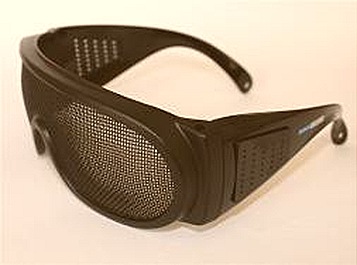
SafeEyes1 Most, if not indeed all, ordinary safety goggles and -“glasses” have one major drawback, when you discount that the lenses scratch very easily indeed, and that is the fogging up in a variety of conditions, leading to loss of vision.

Safe® Eyes mesh safety goggles by Rock Croft, on the other hand, eliminate both of these problems. No fogging and they also are not affected by scratching. On both counts this is due to the fact that the “lenses” are not lenses but are made of a blackened stainless steel mesh. They will also not smear.

While seeing through the mesh takes a little getting used to, much in the same way when using a mesh visor on a chainsaw helmet, one soon does not even really notice the mesh pattern anymore.

The Safe® Eyes goggles are, basically, your mesh visor in goggle/safety glasses format, with the “lenses” being very strong and resistant to many a thing.

While the Safe® Eyes mesh goggles do not protect the whole face, or at least most of it, in the way does your helmet visor does, they do prevent stufgf getting into your eyes. The face heals; your eyes won't.

Often sawdust and bigger particles with much greater velocity, and thus even more dangerous bit than mere sawdust, still can and will get into your eyes despite wearing a helmet with visor – I speak from experience – and it is for that reason that forestry workers in Germany, for instance, now must wear eye protection under the visor.

Safe® Eyes on their own, in fact, would suffice in my opinion and experience, and it makes it thus possible to leave the visor away.

There are a couple of different style of this kind of eye protection, that is to say Safe® Eyes, available and one version, so I was told, I currently on trial with the (US) military.

This would definitely be a product that I am happy enough to endorse and promote.

For more information check out the website at: http://www.meshsafetygoggles.co.uk/ and http://www.safe-eyes.co.uk/

© 2011

Coppicing: a woodland management system of the past for the future

By Michael Smith (Veshengro)

Coppicing is an ancient woodland management practice that needs to be revitalized and reestablished if we want to have a sustainable supply of timber for a variety of purposes. Bean poles are but a small section of this, as is making of lump wood charcoal.

Coppicing Coppicing has been carried out in British woodlands as, more or less, the mode of woodland management until just about the 1960s from night time immemorial.

It was in the 1960s when rather misinformed and misguided “environmentalists”, those who have read a lot but know little to nothing, put a stop to it claiming that those were ancient woodlands that needed to be left to return to their normal state.

Little did they know that they about signed the death warrant for those woods for, without proper continued coppice maintenance those woods will, in fact, die.

Coppice stools that are not maintained will, in the end, break apart and the trees will die. It is as simple as that.

Instead of being bad for woodlands and forests coppicing actually benefits the trees and the environment as a whole.

Much like pruning a rose or a fruit tree to encourage growth, coppicing, basically, has the same effect. Unlike pruning a tree or a rose it is a little harsher and not done as often but, in return, bring usable timber.

Not all trees can be coppiced (or pollarded) and some reproduce better than others.

The great majority of conifers, if not indeed all, do not respond to this treatment and some deciduous trees also do not.

We are lucky, in a way, as far as coppicing goes. It is not rocket science and book knowledge and learning can get it revitalised.

This makes it somewhat different from the use of crosscut saw and other old forestry ways.

Some skills can only be learned from a “master” in the filed, and not (just) from books. The sharpening of saws and axes is one; the setting of saw teeth another and the latter is much more difficult to learn than sharpening.

But, I digressed.

Some people, environmentalists included, still do not get coppicing (or forest management per se) and some, alas, also immediately seem to turn off listening when professional foresters try to make the case for forest management, even the most sustainable types of it.

I have been told, nay accused, more than ones, “but you are a commercial forester!” and aye, that is true but what does that have to do with it and why can a forester not be caring for the environment. In fact all proper ones do.

It is the same with advocating the old “clean forest” police – which even the Forestry Commission is staring to “get”, finally – where all debris, more or less, as in dead branched, tops of felled trees, etc., was taken away from the site (or burned on site) to avoid and prevent the transfer of diseases and also fire ladders.

Today the call goes out that habitat piles is what we need “for the wildlife”, as in fungi and invertebrates, etc.

The fact is that the forests under the “clean forest” policy that I worked in as a young man had more wildlife and were more alive with mushrooms of all kinds and much healthier than are place with hundreds of habitat piles.

Let's take a closer look at the old ways again. They may be able to teach us something about sustainable practices and about making use of everything.

© 2011

Tree marking knife; the sustainable forestry tool

By Michael Smith (Veshengro)

tree-marking-knife This tool, in German called Baumreisser, and produced, predominately by German and Swiss tool makers, such as Victorinox (Switzerland) and Otter (Germany), has been an important tool for the forestry worker and forester in time past.

The tree marking knife, the Baumreisser (tree ripper), was used in the past by forestry workers after a tree had been felled and the branches removed used to mark the cutting length depending on the timber grade. Foresters too used this tool in order to mark trees for removal, either small trees for thinning operations or even large trees in mature stands. Those were marked with a cross, an “X”.

It has, in recent decades, been replaced, some would say superseded, by the spray can and the paint ball gun for marking trees for felling, whether large or small, and even as a marker as to where to make the cuts in a trunk according to timber value and class.

As far as I am concerned, however, the tree marking knife cannot and should not ever be seen as superseded and replaced as spray paint is not sustainable and that for at least two reasons.

Spray paint is costly in the long run and while a tree marking knife costs up to $60, depending on quality and source, it will last a lifetime and more, if looked after. Paint, on the other hand, is costly in the long run. While a can of the stuff may “only” cost a few dollars at a time over time it will be much, much more than the cost of the tool.

The measuring staff of the woodsmen that I have encountered in years gone by in Europe used to have a built-in “bark ripper” for the purpose of marking the place where to cross cut the trunk.

The folding Baumreisser, the tree marking knife, is better though as the forester can carry that with him easily on a “patrol” and mark trees for removal as and when they are noticed.

I encountered such a tree marking knife again only recently on the Felco stand at the 2011 RHS Hampton Court Palace Flower Show when the marketing manager showed me one of which they were given boxes and did not really know what they were for.

Initially even I, as a professional forester, failed to recognize them as I had only encountered them with a fixed blade or as part of another tool and I mistook the took for a hoof knife. Shame on me, I know.

It would appear that makers – some of them at least – are in the process of divesting themselves of the stock of those tools in the – in my opinion false – belief that the end of the tree marking knife has come.

The ones that I saw (and of which I was given a box) are made by Victorinox and are, in fact, no longer shown in their range. German makers still seem to produce them though.

As far as I am concerned we will be looking for this tool in the future again once petroleum – and the pain is based on it – has become unaffordable.

As far as I am concerned the tree marking knife, the Baumreisser, is far from dead and we will find that we will be happy to still have the skills to make them when the time comes and stocks left.

© 2011

A Handbook of Scotland's Forests – Book Review

Review by Michael Smith (Veshengro), RFA 

A Handbook of Scotland's Forests edited by Fiona Martynoga
by Reforesting Scotland
Published by Selaband, Glasgow, 12 May 2011
224 pages, Paperback, illustrated with line drawings
ISBN: 978-188735486-8
Price: £ 9.99
A Handbook of Scotland's Forests

In 224 pages this handbook, while being concise, is remarkable comprehensive and covers about everything anyone needs to know about reforesting, and not just (in) Scotland. 

Despite the fact that the book is talking about Scotland's trees, as the title suggests, it is also similarly applicable to the rest of the British Isles (almost). 

Part one of the book deals with “Three Craft”; the what, where, why and now, including seed gathering, growing and planting and everything in between and related. 

Part two profiles the various species of trees (and shrubs) in Scotland and, as said, to a degree this and the previous part are also applicable to the rest of the UK. 

Exceptions there will be as regards to some laws as Scotland has different laws, legal provisions and legal system in comparison to England (Wales and Northern Ireland), and this also applies to land law and forest law.

A great and most valuable boot for any forester, professional and lay, and anyone interested in reforesting Scotland and other areas of Britain.

© 2011

Woodlands – Book Review

Review by Michael Smith (Veshengro), RFA

Woodlands
by Oliver Rackham
480 pages, hardback, 23.6 x 15.6 x 4.8 cm
Published by Collins as a New edition March 4, 2010)
ISBN: 978-0007315147

‘Trees are wildlife just as deer or primroses are wildlife. Each species has its own agenda and its own interactions with human activities …’

Written by one of Britain’s best-known naturalists, Woodlands offers a fascinating new insight into the trees of the British landscape that have filled us with awe and inspiration throughout the centuries.
Looking at such diverse evidence as the woods used in buildings and ships, and how woodland has been portrayed in pictures and photographs, Rackham traces British woodland through the ages, from the evolution of wildwood, through man’s effect on the landscape, modern forestry and its legacy, and recent conservation efforts and their effects.

In his lively and thoroughly engaging style, Rackham explores woodlands and their history, through names, surveys, mapping and legal documents, archeology, photographs and works of art, thus offering an utterly compelling insight into British woodlands and how they have come to shape a national obsession.
Oliver Rackham has been a great champion for real woods and against the endless postwar conifer plantations – a campaign now largely won. Here he is writing not as a conservationist, but simply to share his prodigious knowledge of woods and trees with the reader.

Rackman, as far as I can ascertain, really knows his subject as regards to woodlands and woodland management and it is refreshing to see and be able to read material such as this.
When the Woodland Trust, however, waffles in their review of the book about restoration of ancient woods and creation of new woods is vital to creating a countryside which is more sympathetic to woodland wildlife, and which delivers benefits to society I would like them to actually show me the “ancient woodlands” that they are referring to.

There are no woodlands in Britain that have never been touched by the hand of man and it is the stupidity of statements such as that that currently may lose us 1,000s of coppice trees in the West Country that are about a millennium old.

Many misguided people have caused working of those woods to stop “ because of the need to restore those to ancient woodlands” not considering the fact that those woodlands had been working coppice woods for the last two thousand years or more.

We must work the woods once again and use them as a renewable resource and not as something just to sit there.

A younger growing tree is more beneficial as carbon sequester too that is an ancient one and with proper renewal such woodlands will reproduce for millenniums to come. Time everyone, and especially the self-proclaimed experts and advocates of the “ancient woodland” began to understand that.
Leaving dead wood on the forest floor is doing no one good either. The so-called habitat piles are – in reality – nothing but bad forestry practice and lead to fire ladders, harbor diseases and the decaying wood not just releases the CO2 the tree had stored during its lifetime but also the much more dangerous greenhouse gas of methane.

Much, much better to actually make the wood into something, especially by means of woodland crafts, from the bodger to other users. Even using that wood that cannot be used for crafts and industry as firewood is better than having it rot down out there in the forest.

Far too long have we allowed our woodland workers to die a slow death. It is time that we, once again, supported them and their products and also encouraged new life into the woodlands by bringing in young people to learn the crafts and skills that, in the not too distant future will once again be as needed as they were before the Second World War.

© 2011